
Housing and shelter, land and property
This section aims to help Syrian refugee and IDP returnees protect their housing, land and property (HLP) rights, secure safe shelter, and navigate claims, documentation, and disputes after return. This section provides practical guidance on common HLP issues and shelter related information.
Housing, Land & Property (HLP) Rights
HLP rights are essential for a safe and dignified return, access to assistance, and livelihood recovery. Many returnees face challenges such as destroyed or damaged homes, secondary occupation of property, or loss of ownership documents.
Proving Ownership or Tenure (HLP documents)
Collect and safely keep any documents that help prove ownership or use of the property. including: title deeds, purchase or sale contracts, utility bills, property tax receipts, court rulings, witness statements, photos of the property, site maps or sketches, or agency attestations in addition to notarized agreements, building permits, and/or civil status extracts (marriage/divorce/birth/death) to establish inheritance lines. Further details can be accessed in the Housing, Land and Propery Guidance accessible via the link below.
If you have lost the ownership documents, try to obtain an official replacement. If you need help, please feel free to contact Legal assistance for IDPs and Returnees
Many HLP claims depend on inheritance verification (deaths, marriages/divorces) and you need legal counseling, please feel free to contact Legal assistance for IDPs and Returnees
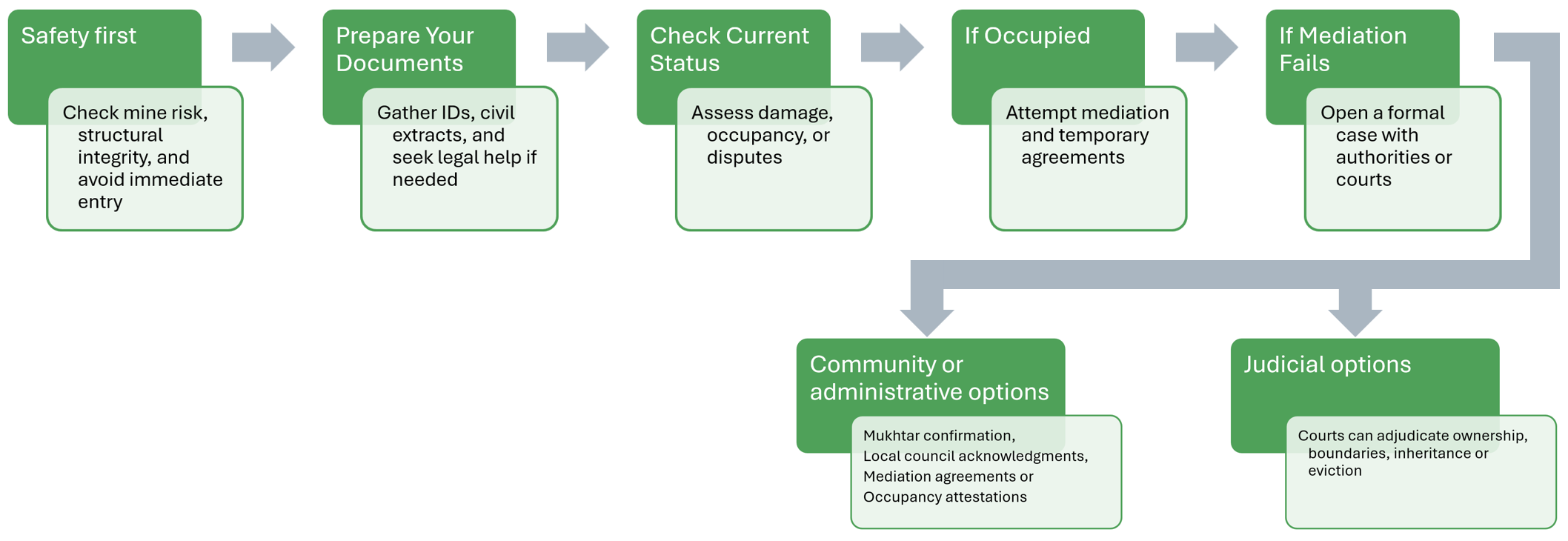
Step by Step: Accessing, Re-using or Reclaiming Your Home/Land
- Safety first: If your property was abandoned for a long time, do not enter it immediate. Check Mine Risk section on the “Protection and Safety” page and confirm if your community or authorities have surveyed or cleared the area or your property. Many HLP incidents occur during rubble removal or agricultural work. Furthermore, areas with heavy destruction may also have structural collapse risks. If possible, request a basic structural assessment from qualified technicians.
- Prepare your documents: Gather all available evidence, including IDs and civil extracts. If documents are missing, seek legal assistance to request replacement.
- Check the current status on the ground: Is the property damaged, occupied by others or under dispute?
- If the property is occupied: Try to resolve the situation peacefully through mediation where possible. Temporary occupancy agreements or rental contracts may help avoid conflict and protect your claim while administrative steps are underway.
- If mediation is not successful: Open a formal case with the relevant authority or court (such as cadastral/real estate court/formal conciliation mechanisms) when accessible. Submit copies of documents only and keep the originals. Where offices are partially functioning (extracts only), lodge written requests and keep stamped receipts as proof.
- Dispute Resolution: Pathways & Expectations:
- Community or administrative options: Mukhtar confirmation, local council acknowledgments, mediation agreements or occupancy attestations are often useful first steps and may support later court cases.
- Judicial options: courts can adjudicate ownership, boundaries, inheritance or eviction. These processes may take time, so patience and proper documentation are important.
Keep comprehensive and organized files
Evidence strategy:
- Build a clear timeline (property acquisition → displacement → current status).
- Organize documents carefully and keep records of all contacts and submissions.
Common Risk Scenarios & How to Mitigate
Below you can find the most common property-related scenarios and practical steps to mitigate them—ranging from documenting evidence and seeking legal pathways to ensuring safety and preserving proof for future claims.
Your home is occupied by another person (secondary occupant)
Avoid confrontation or self forced eviction. Document the situation (photos, witness statements). Seek mediation through the Mukhtar, local authorities or legal aid, or through legal pathways. Keep copies of all written communications and agreements.
Ownership documents are missing or damaged
If replacement documents cannot be obtained immediately, collect alternative proof such as witness statements, photos, tax or utility records, or any past contracts. Request civil status extracts and cadastral searches as systems gradually resume. Keep all receipts and stamped requests.
Your property is looted or damaged
While compensation and restitution mechanisms are limited, report the damage or looting to the police if possible and keep a copy of the report. Take photos and collect witness statements to preserve evidence for possible future claims.
Your home is destroyed or partially collapsed
Do not enter without checking safety first for mines, UXOs or structural damage. If possible, request an assessment from local engineers or authorities. Keep photos and any inspection reports.
Inheritance-related disputes (death during displacement)
Collect civil status documents, such as death, marriage, birth certificates. If documents are missing, seek legal assistance to establish Inheritance Statement through court procedures. Avoid informal division without documentation.
Property boundaries are unclear or disputed
Request cadastral spatial maps or land registry records when available. Use witness statements and Mukhtar confirmation as interim evidence. Avoid physical changes to the land until the dispute is resolved.
Informal or unregistered housing
Gather any proof of long-term use, such as utility bills, neighborhood witnesses, local authority attestations. Seek legal counseling, as information housing cases require individual assessment.
Shelter Assistance
To support returnees, UNHCR and its partners provide housing assistance as part of long-term shelter solutions, through UNHCR supported- community centers. UNHCR also supports the repair of communal basic infrastructure to enhance livelihoods and the basic services to the communities of high return areas.
In order to access this support, returnees will need to approach the closest community center where UNHCR partners will assess the returnee family’s case to confirm eligibility based on defined criteria. If eligible, returnees may receive support to repair their houses which would include moderate structural repairs, doors and windows repairs, electrical works (cabling, installation of lamps, etc.), and water and sanitation work in the residential units, including the common areas, to make the house habitable again. Consent from all right‑holders is needed as it reduces dispute risk.
Water and Sanitation
In many areas across Syria, the public water system is operational and provides access to clean drinking water. However, the quality and availability may vary depending on your location. Many areas receive water through a schedule (for example, once or twice a week), so it’s recommended to have clean storage containers at home. UNICEF and its partners work closely with local water authorities to improve water quality and reliability, especially in heavily affected communities. If you have concerns about water quality, you can contact your local water establishment or ask the community leader for the nearest supported facility.
Basic sanitation services are available in most return areas. These include sewage networks, though functionality can vary by location. In some rural or heavily damaged areas, services may still be under repair or reconstruction. UNICEF supports the rehabilitation of sanitation infrastructure. If sanitation services are not fully functional in your area, local authorities and NGOs are often working to restore them.
Having difficulties accessing safe water or sanitation
If you face difficulties accessing safe water or sanitation, you can:
- Report on the issue to your local water establishment or municipality.
- Call the UNICEF service line 0952535262 (Available Sunday to Thursday, 9:00 AM – 7:00 PM)
- Ask your community leader or mukhtar for guidance on available services.
UNICEF and partners are working to expand support, especially in areas welcoming a large number of returnees. Your feedback helps improve services.