
Documentation and legal matters
Civil documents help you access your rights and services, They are needed to enroll children in school, accessing healthcare, reclaiming your housing or land, accessing assistance. Many people returning to Syria may have lost, damaged, or expired documents, or may need to register vital events (such as births or marriages) that occurred during displacement. This section explains how Syrian refugee returnees and IDP returnees can obtain civil registry documents.
Personal and Family Identification
National ID Card
What it is: Official proof of identity and nationality for Syrians aged 14 and above. Required documents: Personal photos, family booklet, parent’s ID; official stamps/fees.
Step‑by‑step (standard procedure):
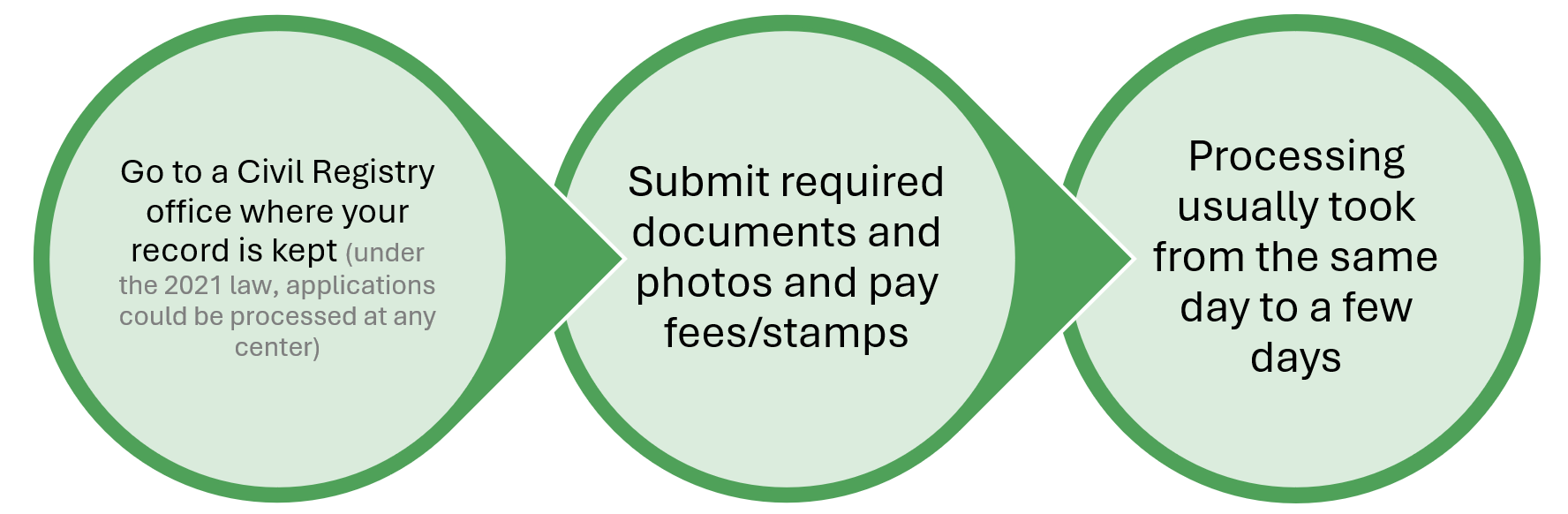
Current situation: Since the fall of the former government, the issuance of family booklets and national ID cards has been suspended by the relevant authorities who plan to introduce new versions of these documents in 2026.
As the current services are limited/suspended:
- Keep proof of identity (passport, family booklet, civil extracts or any prior extracts).
- Request a civil registry extract if available (offices often still issue extracts for already recorded data).
- Keep all receipts, stamped applications or appointment slips for future follow‑up.
- Civil Registry Individual Extract: An individual civil registry extract confirms your personal details. The service can be requested at a Civil Registry office or a Citizen Service Centre. Only a national ID card is required, and the service is currently provided free of charge. An individual extract can be obtained from the day the birth is registered. The service can be requested through a Syrian embassy or consulate by submitting an application and paying the applicable consular fees. First-degree relatives may request this service. Additionally, individuals holding a special power of attorney are authorized to apply on behalf of the concerned individual. A photo can be added upon the applicant’s request by an authorized civil registry employee. The photo is stamped to validate its authenticity.
Please note: The national number is unique and permanent. It is assigned at birth registration and cannot be changed. It remains consistent across all official documents issued to a citizen, including the family booklet, national ID card, and passport.
Family Booklet & Civil Registry Extracts
Family booklet records the nuclear family (spouses, children). Individual/family extracts are frequently required for school enrollment, aid, banking, and court procedures. The family booklet primarily serves to record family-related events such as births, deaths, and divorces. In some cases, it may also be used to register for and access assistance provided by some NGOs. The family booklet cannot be used as a substitute for a national ID card or for conducting official transactions with government authorities.
Issuance: A family booklet may be requested by the head of the family – either the husband or the wife – at any Civil Registry Office. If one or both spouses are outside Syria, the application can be submitted by a first-degree relative (such as a parent or adult child) or by a legal representative holding a special power of attorney for this purpose (specifically authorizing them to apply for the issuance of the family booklet on behalf of the applicant). The absence of a photo in the family booklet does not affect the validity of the family booklet; it remains legally valid.
Current situation: Since the fall of the former government, the issuance of family booklets and national identity cards has been suspended by the relevant authorities who plan to introduce new versions of these documents in 2026.
For civil registry extracts, issuance is ongoing for those who had their civil events recorded.
Replacement: A second family booklet can only be issued if the original has been lost, and this must be substantiated by an official police report.
If lost/damaged, prepare secondary evidence (old copies, photos, UNHCR refugee cards, mukhtar statements). These support replacement once services resume.
When a second family booklet is issued due to loss of the original, the new booklet is marked as a replacement in the remarks section. All previously registered information, including recorded deaths, will also appear in the replacement booklet.
Application requirements
To apply for a family booklet, the following documents are required:
- Applicant’s national ID card (husband or wife).
- Marriage certificate.
- Family civil extract.
- Personal photograph.
A family booklet can be obtained once the marriage has been registered with the competent court and the marriage certificate has been transmitted from the court to Civil Affairs Directorate.
Adding a child inside Syria
To add the child to the family booklet, parents must first register the birth at the civil registry office. If the birth certificate was issued abroad, it must first be registered in the Syrian civil records before the child can be added to the family booklet.
Once the birth is registered in the Civil Registry, a child may be added to the family booklet by one of the parents, a first-degree relative (such as a grandparent or an adult sibling) if the father is abroad or deceased, or by a legal representative holding a power of attorney for this purpose, regardless of the parents’ location. The only required document is the child’s birth certificate.
Adding a child outside Syria
It is not possible to add a child to the family booklet through a Syrian consulate or embassy. Registration in the family booklet can only be completed in Syria through the civil registry offices and requires presenting the child’s Syrian birth certificate.
The place of birth recorded in the birth certificate reflects the actual location of birth, not the place of registration. Therefore, if the child was born outside Syria, the foreign place of birth will be officially recorded.
To add the child to the family booklet, parents must first register the birth. If the birth occurred abroad, they should approach a Syrian consulate or embassy to register it and issue a Syrian birth certificate. Applicable consular fees must be paid to obtain this service. Upon return to Syria, the parents can present this certificate to the relevant civil registry to add the child to the family booklet. If the birth was not registered at a Syrian embassy, it must be registered in Syria as a prerequisite for inclusion in the family booklet.
Family Extract: If the marriage is already registered with the Civil Registry, only the applicant’s ID card is required. The request must be submitted in person by the concerned individual or by someone legally authorized to act on their behalf.
Close relatives (first-degree family members) are permitted to request this document. Other persons may also apply, provided they hold a special power of attorney authorizing them to obtain family records on behalf of the concerned individual.
Syrian citizens residing abroad can request a family record (family extract) through a Syrian embassy or consulate. Applicable consular fees must be paid to obtain this service.
A child cannot personally request this service. One of the parents can or a first-degree relative (such as a grandparent or uncle) or a legal guardian may request family or individual civil records on the child’s behalf.
Passport
Passports are issued by the Immigration & Passports Department. If your passport is lost, start replacement steps before travel when possible.
Inside Syria
Syrian citizens can apply for new passports through the Ministry of Interior electronic platform; link: Anjez
Outside Syria
Passport issuance through Syrian diplomatic missions and electronic consular offices follows the appointment-based system currently used by each diplomatic mission.
Syrians returning to Syria are required to present valid identification, such as a Syrian passport or national ID card, to enter. Passports and ID cards issued by the former government remain valid. Individuals without valid documents but who are registered in the Syrian civil registry may still be allowed to enter Syria after their identity is verified through the Civil Affairs database at border checkpoints. In such cases the returnees may issue a civil record extract for entry.
Additionally, Syrian diplomatic missions abroad are authorised to issue temporary travel documents and passports to facilitate the return of nationals who had lost them. Replacement of lost ID cards can only be done in person inside Syria. UNHCR provides free legal assistance through its partners to IDPs and returnees on issues related to civil documentations including IDs.
Registering Civil Events (Birth, Marriage, Divorce, Death)
Birth Registration
Birth certificates and certificate extracts are issued by the Civil Registry Office and Citizen Service Centres, the only authorized entities to issue official civil status documents.
Birth Registration of children born Inside Syria
- Identification documents of both parents
- Valid marriage certificate or family booklet.
- Birth report, as follows:
- If the child was born in a hospital, the hospital issues the birth report.
- If the child was born outside a hospital, a licensed doctor or certified midwife issues the birth report.
- If obtaining a birth report is not possible, the birth can be registered through a court case.
The birth must be officially registered at the local Civil Registry Centre.
Where the father of a child is unknown, filiation to the mother can be established through a Sharia court case, based on:
- The mother’s civil registry record
- The child’s birth attestation issued by a medical facility or certified medical personnel
On the basis of the court ruling, the child is formally registered in the civil registry, assigned a father’s name and surname, and a birth certificate is issued.
Birth registration in Syria for children born abroad
Register birth under host country law → authenticate → submit to Syrian embassy/consulate, which forwards to civil registry in Syria for recording. Applicable consular fees will apply to obtain this service.
Note:
Deadlines & fines: Under the 2021 Civil Status Law, births must be registered within one year. Late registration is subject to fines. If local civil registry is not currently accepting new entries, collect and keep all supporting documents for future submission.
If services are limited or temporarily suspended:
- Keep hospital birth reports, embassy attestations, and any temporary local records in a safe place.
- Request an official receipt or written acknowledgment whenever possible.
Seek legal assistance to preserve the child’s rights and prevent and reduce statelessness/absence-of-documentation risks.
Birth Registration Outside Syria
Steps for Birth Registration Abroad
- Register the Birth in the Host Country
- Obtain an official birth certificate from the local civil authority where the child was born.
- Ensure the certificate includes full details (child’s name, parents’ names, date and place of birth).
- Legalize and Authenticate the Birth Certificate
- Legalize or apostille the birth certificate according to the host country’s procedures.
- Authenticate it through:
- Host country’s Ministry of Foreign Affairs (or equivalent).
- Syrian embassy or consulate in that country.
- Submit the Documents to Syrian Authorities/Syrian Civil Registry
You may choose one of the following options:
- Through the Syrian Embassy/Consulate
- Submit the legalized birth certificate to the Syrian embassy or consulate.
- The embassy will ratify and forward the document to the Civil Registry in Syria.
- Once processed, the birth will be recorded in the Civil Registry.
- Direct Submission in Syria
- Upon return to Syria, you can submit the legalized birth certificate directly to any Civil Registry Centre.
- Submission can be made by:
- One of the parents,
- A relative up to the fourth degree,
- A legal representative holding a power of attorney.
Please note: Births must be registered within one year of occurrence. Late registration results in fines under the 2021 Civil Status Law. If registration services are temporarily suspended or limited, keep all original documents, attestations and receipts for future submission. Legal assistance is recommended to safeguard the child’s right to nationality and prevent statelessness.
Marriage Registration
Registering a marriage is essential to protect family rights. Under Syrian law, a child cannot be officially registered with the Civil Affairs Directorate if the parents’ marriage is not legally documented, whether the marriage is customary or informal.
Marriage Registration Inside Syria
Marriage registration involves both Sharia (religious / family) courts and civil registries ; civil marriages are not contracted inside Syria. The legal age of marriage has been raised to 18 for both spouses.
Usual steps:
- Sharia court issues a marriage certificate after the required conditions are met (mutual consent, witnesses, civil status certificates, medical certificates)
- The marriage certificate is sent to the Civil Registry (within the statutory timeframe) to record the marriage.
If services are limited or partially suspended:
- Keep the original Sharia court marriage certificate and file an application to register the marriage once civil registry services resume.
- Where courts function but civil registries do not, ensure all fillings are timestamped and court receipts, as they are essential proof.
For marriages conducted outside the Sharia court system and for those seeking to authenticate the marriage, please seek individual counseling at link: Legal assistance for IDPs and Returnees
Marriage Registration Outside Syria
When married outside Syria and willing to register the Marriage in the Syrian Civil Registry.
Step 1: Obtain an Official Marriage Document Abroad
- Obtain the official marriage certificate or statement issued by a competent state court or civil authority in the country where the marriage occurred. The document must comply with local laws and be a fully legal document (not informal or religious-only).
- Ensure the marriage does not conflict with Syrian law (e.g., minimum age requirements).
Step 2: Authenticate & legalize the document
- Legalize or apostille the foreign marriage certificate according to the host country’s procedures.
- If required, authenticate the document through the host country’s Ministry of Foreign Affairs or equivalent authority.
Step 3: Submit the Document to Any Civil Registry Centre (CRC) in Syria
You may choose one of the following options:
- Direct Submission in Syria
- To submit a foreign-issued marriage certificate at the CRC, it must first be legalized (stamped) by the Syrian embassy or consulate in that foreign country.
- Any eligible person (one of the spouses, a relative up to the fourth degree, or a legal representative with power of attorney) submits the legalized marriage certificate to any Civil Registry Centre (CRC) in Syria.
- The CRC verifies the authenticity of the document and compliance with Syrian law.
- The marriage is then registered electronically in the Civil Registry.
- Submission via Syrian Embassy or Consulate
- Submit the legalized marriage certificate and required attachments to the nearest Syrian diplomatic mission abroad.
- The embassy ratifies the documents and forwards them to a Civil Registry in Syria. Consular fees might apply.
- The marriage is registered in the Syrian civil registry.
Marriages concluded abroad can be recorded in the Syrian Civil Registry once properly authenticated. For marriages registered in non-Arabic countries, an officially certified translation of the legal foreign marriage certificate is needed.
Divorce Registration
Under Syrian law, a divorce becomes legally valid once a ruling is issued by the Sharia Court. However, registration with the Civil Affairs Directorate is essential for the divorce to be reflected in official records and serve as legal proof in administrative and civil matters. The date of the Sharia Court ruling is the official date recognized by the authorities for legal and administrative purposes.
Divorce Registration Inside Syria
Divorce registration involves both the Sharia court and the Civil Registry; timely registration is important to protect rights such as the ability to remarry, inheritance and child custody. Divorce may be issued in the presence of the two spouses or pronounced by the husband in the absence of the wife, in accordance with the law.
If services are limited or partially suspended: Proceed with court process if possible and keep all attestations, court rulings and receipts. Submit the divorce for registration with the Civil Registry once services resume.
If you need legal counseling, please feel free to seek free individual counseling at link: Legal assistance for IDPs and Returnees
Divorce Registration Outside Syria
If the divorce was finalized abroad, it must be registered in the Syrian Civil Registry to ensure that your civil status records are updated and to protect rights related to inheritance, custody, and remarriage.
Steps:
- Obtain the official divorce decree/certificate from the foreign court or competent authority.
- Legalize or apostille the decree according to the host country’s procedures.
- Authenticate the document through:
- Host country’s Ministry of Foreign Affairs (or equivalent).
- Syrian embassy or consulate in that country. Consular fees will apply.
- Submit the document to Syrian authorities through one of the following options:
- Option A: Through the Syrian embassy/consulate, which forwards the document to the Civil Registry in Syria.
- Option B: Directly at any Civil Registry Centre in Syria (by one of the spouses, a relative up to the fourth degree, or a legal representative with power of attorney).
- The Civil Registry will verify compliance with Syrian law and record the divorce in the Civil Registry system.
Please note: Under the 2021 Civil Status Law, divorces should be registered without delay. Late registration may result in fines. If civil services are temporarily suspended or provide limited services, keep all original documents including any temporary local records, embassy attestations and receipts for future submission. Request an official receipt or acknowledgment from any authority you contact whenever possible, and seek legal assistance to avoid complications related to inheritance or remarriage. If you need legal counseling, please feel free to seek free individual counseling at link: Legal assistance for IDPs and Returnees
Death Registration
Why Register a death?
Recording a death in the Syrian Civil Registry is essential for: securing inheritance rights, updating family records and/or accessing pensions and other legal entitlements
To obtain a death certificate, the deceased individual’s family must submit the required documents to the Civil Registry within the legal timeframe:
- If the death occurred inside Syria: The application must be submitted within three months by a family member up to the fourth degree of kinship or a person holding a legal power of attorney. Late registration may result in fines.
If the death occurred abroad: The applications must be submitted within nine months, and can be filed by a family member.
Please note: under the 2021 Civil Status Law, deaths must be registered without delay. Late registration may result in fines. If civil registry services are limited or temporary suspended, keep the foreign death certificate, embassy attestations, burial documentation and any receipts or written acknowledgments safe, You may wish to seek legal assistance to protect inheritance and family rights.
Death Registration Inside Syria
To obtain a death certificate, the following documents are required:
- A medical report issued by a licensed doctor or hospital (public or private) confirming the death.
- The medical report must be certified by the Directorate of Health.
- The deceased’s national ID card and family booklet.
Family members up to the fourth degree of kinship may apply directly. Individuals outside this category must present a legal power of attorney authorizing them to act on behalf of a relative of the deceased.
Death Registration Outside Syria
Steps:
- Obtain the official death certificate from the competent authority in the country where the death occurred.
- Legalize or apostille the death certificate according to the host country’s requirements.
- Authenticate the document through:
- Host country’s Ministry of Foreign Affairs (or equivalent). and
- Syrian embassy or consulate in that country. Consular fees will apply.
- Submit the document to Syrian authorities through one of the following options:
- Option A: Through the Syrian embassy/consulate, which forwards it to the Civil Registry in Syria.
- Option B: Directly at any Civil Registry Centre in Syria (by a family member up to the fourth degree or a legal representative holding power of attorney).
- The Civil Registry will verify compliance with Syrian law and record the death in the Civil Registry system.
Nationality & Preventing Statelessness
Syrian nationality is primarily based on descent through the father . Children born to Syrian mothers and foreign fathers do not automatically acquire Syrian nationality. Practical implications for returnees:
- If the father is absent or unknown, consult legal aid as early as possible to identify available options and required evidence (such as birth certificates, witnesses, court rulings).
- For Kurdish communities affected by past denationalization, and other groups at risk, an individual counseling is recommended.
Reducing Risk of Being with No personal Documents
- Register births as early as possible and keep authenticated documents if registration is delayed.
- Seek embassy/consulate support for events that occur abroad, and NGO legal assistance to address documentation gaps.
- Monitor legal deadlines under Syrian law (e.g., birth registration within one year to avoid fines).
You can contact UNHCR legal aid partners for support and free individual counceling at: Legal assistance for IDPs and Returnees – UNHCR Syria
Useful Websites and Addresses (Damascus & Syria wide)
Ministry of Justice – Damascus HQ (for complaints & information)
- Address: Damascus, Mazzeh Autostrade, before Dar Al‑Baath.
- Phones: +963-011-6661260 / 6661270 / 6662469 (availability may vary).
Legal Framework
- Civil Status Law No. 13/2021 and its previous amendment in 2019
- Nationality Law (Legislative Decree 276/1969)