
Education
Access to education is a vital step toward rebuilding lives and securing a better future. This section provides essential information for families and young people returning to Syria, including guidance on school enrollment procedures, document requirements, and alternative learning options for children who have missed school. You will also find details on programs for adolescents and youth, such as vocational training, life skills, and community engagement activities, as well as opportunities to join youth clubs and cultural initiatives. Explore the resources below to help ensure every child and young person can continue learning and growing.
School Enrollment
The Ministry of Education has opened its schools to all children and has shown flexibility by accepting late school registration for any students. You should submit the document of last grade your child studied to the Education Directorate of the governorate you are residing in.
On 11 September 2025, the Ministry of Education instructed to facilitate the school registration procedures for children, especially for children returning from abroad for the 2025-2026 school year. You can register your children through conditional registration based on the available documents provided or through the submission of a written pledge confirming the accuracy of the information and committing to complete the supporting documents (i.e. marriage certificate, statement of birth) before the beginning of the second semester.
According to the MOE instructions, the child’s parent/caregiver bares the full responsibility in the event of failure to provide the required documents, and no academic certificate shall be given in case of such failure.
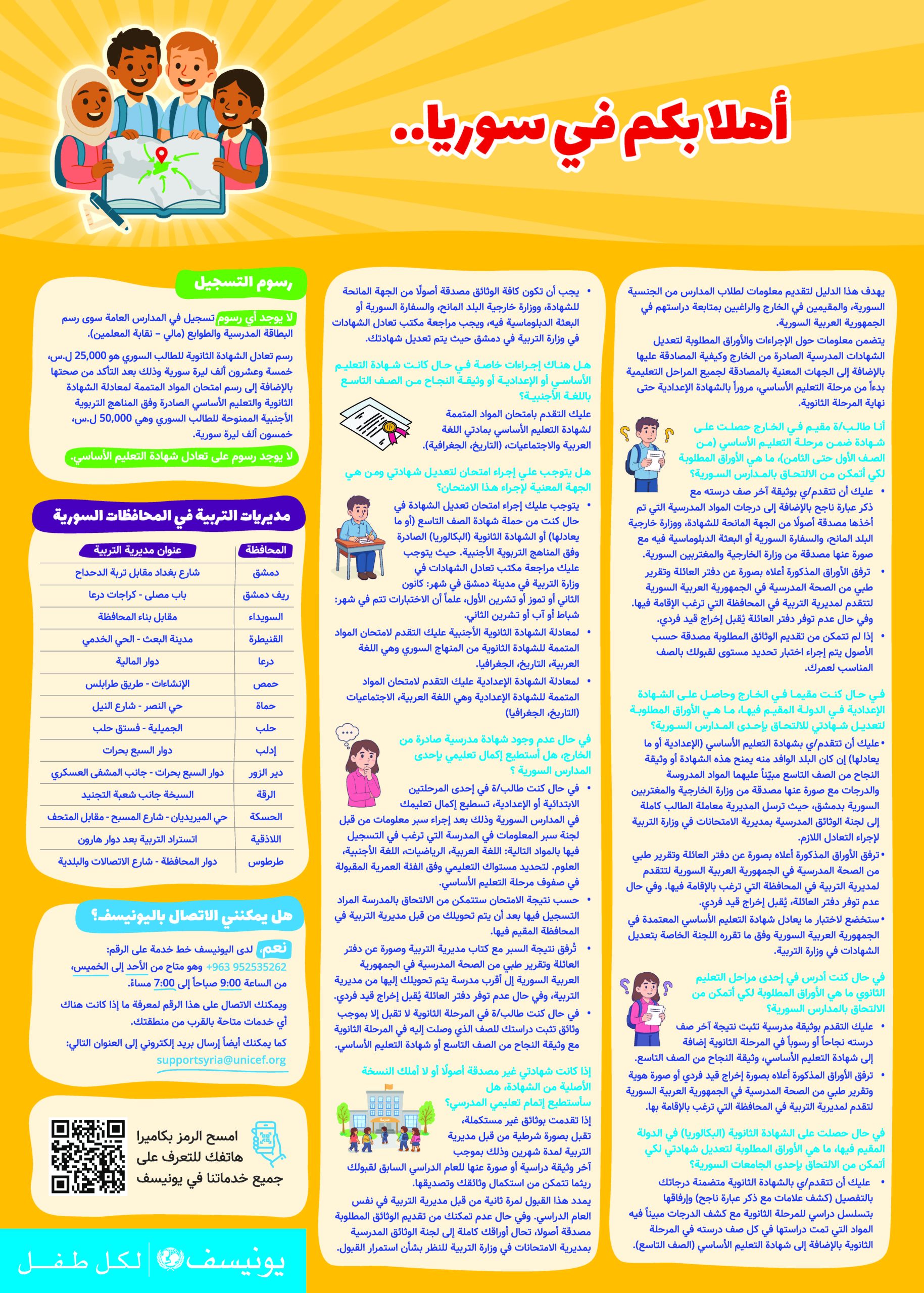
Additional Governmental Measures to Support Access to Education in Syria
The Syrian Ministries of Higher Education and Education have introduced exceptional measures to ease the reintegration of returning students, including extended registration deadlines for university students who interrupted studies throughout the crisis, conditional exam eligibility, and facilitated enrollment for returnees from abroad under Decree No. 95 of 2025. School directorates have also been instructed to accept certificates endorsed by foreign principals without embassy/consular authentication, or to place students through age-appropriate tests where documentation is missing.
These steps aim to reduce bureaucratic hurdles, safeguard the right to education, and send a reassuring signal to refugee families, while creating space for UNHCR to engage national authorities on equitable access, and broader return guarantees.
Returnees from Türkiye Authorized to Apply for University Admission Using Turkish Documents
On 7 October 2025, the Ministry of Higher Education and Scientific Research announced that Syrian students who obtained high school certificates in Türkiye—and whose names appear differently on Turkish immigration documents compared with their original Syrian records—may apply for public university admission through the official application platform. The Ministry authorized these students to register conditionally using their Turkish academic documents, provided they submit their original Syrian documents upon final admission to verify name consistency and complete enrollment procedures. This decision reflects the Ministry’s efforts to facilitate the application process for Syrian students returning from abroad, ensuring that formal discrepancies in documentation do not hinder their educational opportunities.
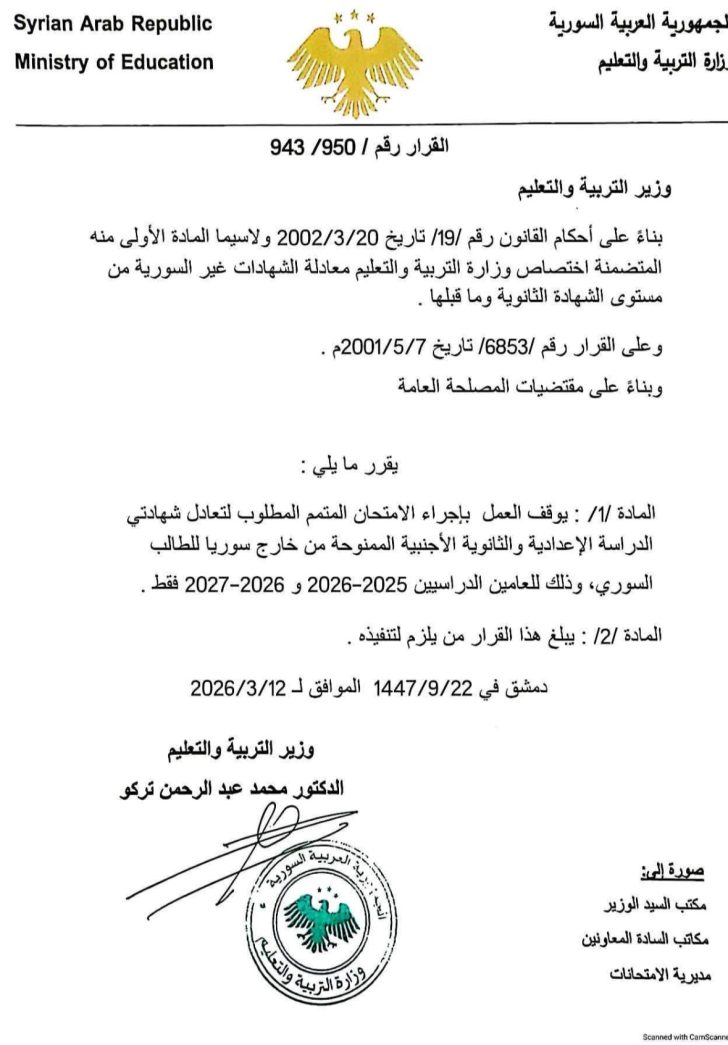
Announcement: New Decision by the Syrian Ministry of Education
The Ministry of Education issued Decision (No.943/950) that stipulates the suspension of conducting the complementary examination required for the equivalency of foreign certificates of the 9th and 12th grades granted to Syrian students outside Syria. This suspension applies only to 2025–2026 and 2026–2027 academic years.
Step-by-step guide
The steps for Syrian children returning from abroad to enroll in school and access available educational and learning opportunities in Syria are divided in three main phases:
Phase I: Before Leaving Your Host Country
✓ Obtain your education transcript showing the successful completion of your last educational level that you attended, including a stamped and certified certificate outlining your academic achievements from the educational provider (school or organization).
✓ Certify the transcript through the Ministry of Foreign Affairs in your country of residence.
✓ Obtain certification from the Syrian Embassy or diplomatic mission in your country of residence.
Consular fees may apply.
Phase II: Upon Arrival in Syria
✓ Certify all documents through the Syrian Ministry of Foreign Affairs and Expatriates in Damascus.
✓ Submit the Family Booklet or an extract family certificate from the civil registry.
✓ Obtain a medical report from the school health department.
Phase III: Final Registration with the Education Authorities
✓ Submit all required documents to the Directorate of Education in the governorate where your family resides. This includes:
- School registration application
- Guardian’s signed commitment to keep the child in school until the completion of basic education
- Copy of the child’s birth certificate or civil registry entry
- Copy of the relevant Family Booklet page showing the father, mother and child
- Copy of the guardian’s personal ID
- Three passport-sized photos of the child
- Health card from the school health clinic
Education Options for children not attending school
Children and adolescents who are not currently enrolled in school can access several programs to continue learning and prevent dropout. Options include formal education, accelerated programs to catch up on missed years, and non-formal learning through activity-based materials for core subjects. Additional support is available through remedial education to improve academic performance and literacy programs for those who missed foundational skills. These pathways help learners reintegrate into education and build essential knowledge for the future. The following learning opportunities are available:
📘 Formal Education
Standard school-based education following the national curriculum.
📚 Non-Formal Education – Empowered Learning Materials (ELM)
An activity-based, non-formal learning curriculum supporting self-learning and skills building for Grades 1-9 in foundational subjects of Arabic, French, English, Mathematics, Science, Physics, and Chemistry.
📝 Literacy Programmes
Basic reading and writing courses for children and adolescents who missed foundational education.
⏩ Accelerated Formal Education – Curriculum B
A condensed formal education program aimed at enabling students to make up for one or more missed school years and successfully reintegrate into the formal education system.
🔁 Remedial Education
Targeted academic support to help learners improve their performance and keep up with their peers.
Learning Opportunities for young people
Young people aged 10-24 can join various learning programs supported by UNICEF. These include:
- Life skills citizenship education
- Technical vocational training
- Job readiness and entrepreneurship programs
- Health awareness sessions
- Sessions related to environment and climate change
These programs are offered in 43 Adolescent-Friendly Spaces and 30 mobile teams run with local NGOs in 10 governorates, and in more than 70 cultural centers of the Ministry of Culture across 14 governorates.
All programs are provided in safe, supportive, and inclusive spaces that welcome both girls and boys. They focus on peer-to-peer learning and are tailored to be age- and gender-sensitive.
Children and Youth Clubs
43 Adolescent-Friendly Spaces and 30 mobile teams run with local NGOs in 10 governorates, and more than 70 cultural centers of the Ministry of Culture across 14 governorates offer opportunities for adolescents to:
- Join youth clubs and engage in sports, art, and cultural activities
- Participate in community service or volunteer projects
- Learn how to design and lead their youth initiatives
These spaces help young people build confidence, connect with peers, find support, and foster their positive social, civic, and digital engagement and resilience while promoting inclusion, social cohesion, and inclusivity.
Job readiness, apprenticeships or entrepreneurship programs
Youth aged 15-24, including those returning to Syria, can access training that helps prepare them for work. They can access such training in 43 Adolescent-Friendly Spaces and 30 mobile teams run with local NGOs in 10 governorates, as well as more than 70 cultural centers of the Ministry of Culture across 14 governorates. Training includes:
- Life skills and transferable “soft” skills
- Vocational and technical training (including digital and skills related to climate change)
- Entrepreneurship and small business development
- Apprenticeship and on-the-job training opportunities, in collaboration with small businesses, cities, or chambers, like in Aleppo
These programs aim to support youth in finding decent work and building a better future, while encouraging resilience and social cohesion.